


Over three days, the 17th ITS European Congress in Istanbul marked a defining moment for intelligent transport in Europe and beyond. The discussions demonstrated clear progress towards integrated, safe, and seamless mobility, while also reinforcing that further efforts are needed to accelerate deployment across key areas.
Multiple examples presented throughout the Congress confirmed that European ITS delivers tangible impact while supporting the development of solutions to achieve a more accessible, affordable, resilient mobility future, aligned with the goals of zero fatalities and zero emissions. At the same time, the scale and complexity of implementation highlighted the need for stronger collaboration, alignment, and real-world deployment.
A closing ceremony reflecting progress and ambition
This year’s closing remarks were delivered by Joost Vantomme, CEO of ERTICO – ITS Europe. Alongside his presentation of the Congress outcomes and the main programme highlights, Chief Rapporteur Professor Eric Sampson’s video address provided a consolidated overview of the insights and a preview of the forthcoming Post-Congress Report.
Both of their reflections, gathered in close cooperation with the team of Rapporteurs on-site, gave a compelling summary:
1. Safety and resilience through intelligent systems
The first topic reflected the strong momentum behind Connected, Cooperative and Automated Mobility (CCAM), focusing on development, deployment, and real-world use, with V2X communication, Cooperative-ITS (C-ITS), infrastructure support, and simulation environments forming a cornerstone of Europe’s long-term safety and automation strategy.
Software-Defined Vehicles (SDVs), combined with open data exchange standards and full interoperability, were identified as key enablers for socially inclusive electrification and for addressing mobility gaps in urban and peri-urban areas with scalable and secure solutions.
A strong emphasis was also placed on smart infrastructure and operational systems. Automated traffic management, real-time monitoring through sensor networks, and cooperative systems integrating perception, communication, and control demonstrated how infrastructure and vehicles are increasingly interconnected.
At the same time, research examined the limitations of advanced driver assistance systems, including driver distraction and drowsiness detection. This highlighted the need for improved reliability, calibration, and human–machine interaction.
A notable development was the growing use of data-driven safety analysis. Large, connected vehicle datasets were used to identify emerging risk hotspots and calculate surrogate safety measures, offering strong potential for proactive safety management at scale.
2. Multimodal mobility system management
Moving beyond traditional traffic management towards a broader “system-of-systems” perspective, the second topic brought reflections upon integrated approaches of Mobility as a Service (MaaS), active mobility, AI, digital twins, CCAM, data governance, and public-private collaboration.
While progress was evident, fragmentation remained a key challenge. Scaling solutions continued to be constrained by interoperability gaps, governance misalignment, uneven data quality, and implementation barriers. Nevertheless, there was a clear transition from isolated pilots to integrated, platform-based mobility systems.
Equity, inclusion, accessibility, and affordability remained central themes, with increased attention on vulnerable users and inclusive-by-design mobility. User behaviour also emerged as a critical factor, reinforcing that technological solutions must be supported by behavioural change to achieve long-term success.
Electrification, particularly of buses and coaches, was highlighted as a promising pathway to reduce greenhouse gas emissions and improve urban liveability. However, challenges remain, especially for long-distance operations and infrastructure deployment, requiring coordinated technological and policy responses.
3. Smart and sustainable logistics in the digital era
The third topic brought focused attention to key challenges in logistics. New analytical tools and frameworks were presented to assess cost-benefit outcomes for heavy vehicle charging infrastructure, supporting more informed decision-making across freight corridors.
Innovation was also evident in specialised logistics domains, for example, agriculture, where digital solutions are supporting regulatory compliance and improving trust among stakeholders.
A notable highlight was a new approach to autonomous last-mile delivery, combining electric vehicles with event-triggered remote assistance. This model integrates automation with human oversight, ensuring safety in complex environments while enabling scalable, zero-emission delivery services.
At a systemic level, the lack of interoperable data sharing across European logistics chains remains a significant barrier. A federated network of platforms, enabling Business-to-Business and Business-to-Administration data exchange, was proposed as a practical solution. This approach has already been demonstrated through the FENIX project across multiple TEN-T corridors and maritime routes.
4. Enhancing transport and mobility beyond the road
Papers and discussion sessions highlighted both opportunities and gaps in current approaches for exploring emerging mobility domains.
Discussions pointed to limitations in existing regulatory frameworks and raised the need for more holistic approaches to data regulation. Integration between transport modes, particularly in relation to user acceptance of automated services, was identified as an area requiring further attention.
In aviation, research explored the potential of vertical take-off and landing (VTOL) systems to support the European Commission’s vision of four-hour door-to-door travel. Case studies demonstrated the importance of timetable integration and strategic placement of infrastructure, such as vertiports, to enhance user experience.
A recurring theme was the need to involve society earlier in the innovation process. Moving from end-user validation to co-design and participatory approaches was identified as essential for successful and inclusive deployment.
A complete experience for all
The closing ceremony was completed with ERTICO Chairman Dr Angelos Amditis’ speech on the strong success of this year’s Congress edition, highlighting the key figures and a warm thank you to everyone involved. We also heard the final messages from Erdem Samut, CEO of İSBAK, and Professor Dr Volkan Demir, Secretary General of the Istanbul Metropolitan Municipality, who echoed this sentiment and reinforced the local and international significance of the event for the City of Istanbul.
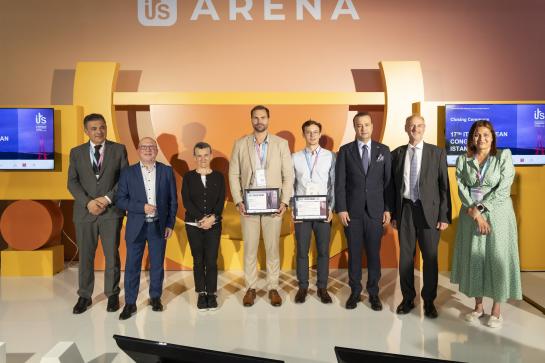
Finally, the ceremony also honoured:
- The Best Technical Paper Award on 'Robust and Safe Deployment of C-ITS in Sweden' was presented to Victor Jarlow, Magnus Westling, Noel Alldritt, Aras Kazemi, and Björn Selander (AstaZero, Trafikverket, Stiftelsen för Internetinfrastruktur, Digitraffic).
- The Best Research Paper Award, sponsored by the Institution of Engineering and Technology (IET), was awarded to Lennart Querfurth, Hubert Rehborn, Marc Zürn, and Silja Hoffmann (Mercedes-Benz AG and Bundeswehr University Munich).
- Runner-up Research Paper Award, presented to Dr Burcu Uzun Ayvaz, at the University of Surrey, for ‘Influence of Electricity Supply and Seasonal Variations on the Well-to-Wheels Environmental Performance of Long-Haul Battery Electric Trucks Across Vehicle Classes.’
- Best Session Award: SIS 10: 10 years of C-ITS Deployment in Europe, by Daniela Wollrab (Moderator), Lea Kaiser (Organiser) and speakers Martin Boehm, Razvan Racu, Malika Seddi and Geert van der Linden.
Looking Ahead
With a forward-looking perspective, Darren Capes, Head of Road Infrastructure Technology at Department for Transport at the UK Department for Transport, presented an outlook towards the 33rd ITS World Congress 2027 in Birmingham, while also inviting participants to engage at the upcoming 32nd ITS World Congress 2026 in Gangneung, South Korea.
The ITS European Congress in Istanbul reinforced a clear message: the future of mobility is exciting, but it will depend not only on innovation, but on the ability to connect systems, data, and stakeholders.
With this momentum, the ITS community moves forward, focused on accelerating deployment and delivering integrated, safe, and seamless mobility at scale.
The final Congress Report will be available in the next few weeks.
Subscribe to the Congress news for more announcements.