

On 23 June, ERTICO – ITS Europe had the great pleasure to be invited to the Conference of European Directors of Roads (CEDR) ISAC project's final event, bringing key insights from across the mobility ecosystem to a high-level panel discussion featuring the European Commission and leading road authorities.
The Intelligent Surface Access Community (ISAC) project, part of the CEDR Transnational Research Programme, addresses a critical turning point for National Road Authorities (NRAs). Faced with tightening budgets and urgent climate targets, NRAs from Finland, Ireland, the Netherlands, Norway, and Sweden are exploring how Intelligent Access (IA) can optimise infrastructure use and advance sustainable freight transport.
From Static Regulation to Dynamic Access Management
The core philosophy of ISAC marks a profound paradigm shift in freight governance: moving away from traditional, infrastructure-centric enforcement, such as fixed weighing stations, manual inspections, and induction loops, towards data-driven access management. The objective is to leverage connected vehicles, digital logistics platforms, and real-time compliance to ensure the right vehicle, with the right load, on the right road, at the right time.
This transition transforms infrastructure managers from reactive enforcers into proactive, predictive operators. It also reframes the ongoing revision of the Weights and Dimensions Directive. The debate is no longer just about heavier or longer trucks; it is fundamentally a digital file. To support decarbonisation, Europe must pair new vehicle configurations, like zero-emission and high-capacity trucks, with digital compliance frameworks.
The principal barrier ahead is not the technology itself, but interoperability. Because freight transport is inherently cross-border, Europe requires common architectures, harmonised standards, and trusted data spaces to avoid a fragmented patchwork of national digital environments.
ERTICO Building Blocks: Driving Compliance by Design
During the panel, ERTICO, represented by CEO Joost Vantomme, highlighted how its extensive project portfolio directly delivers the operational building blocks required to make Intelligent Access a reality across Europe. ITS is not just about traffic management. It has become a key enabler of freight policy, infrastructure policy and industrial competitiveness.
- NextETRUCK: Demonstrates the "right vehicle" concept by deploying next-generation electric medium-duty trucks. Instead of relying on static infrastructure checks, the project utilises high-fidelity Digital Twins and modular IoT architectures. Real-time vehicle-generated data, such as battery State of Health (SoH) and operational states, enables predictive access management, while AI-driven tools manage eco-routing and smart charging via standardised interfaces like ISO 15118.
- FENIX & FEDeRATED: These initiatives lay the groundwork for federated freight data sharing and logistics interoperability across Europe, establishing the trusted, cross-border data spaces needed to track digital transport documents and vehicle configurations securely.
- STORM: Focused on smart freight methodologies and big data analytics, STORM developed a comprehensive toolbox utilising data fusion and agent-based modelling. These methodologies provide precise indicators, such as infrastructure utilisation, road wear, and emissions, that NRAs need to define and manage dynamic access conditions.
- ENSEMBLE: A landmark project that tackled multi-brand truck platooning, proving that connectivity and interoperability can function in unison across different vehicle manufacturers and national borders under real-world traffic conditions.
- 5G-MOBIX: Addressed critical cross-border CAM (Connected and Automated Mobility) functionalities through extensive trials along European corridors, resolving vital technical hurdles in service continuity, roaming, and data management at national borders.
- MACBETH & PoDIUM: Further bridge the gap between vehicles and infrastructure. MACBETH focuses on the scalable deployment of Megawatt Charging Systems along TEN-T corridors, ensuring interoperability, while PoDIUM leverages Digital Twins and edge computing to advance real-time automated operations.
Joost also highlighted the role of data sharing for road safety through the DFRS (Data For Road Safety) platform with road authorities, vehicle manufacturers and service providers.
The future of European road management lies in compliance by design
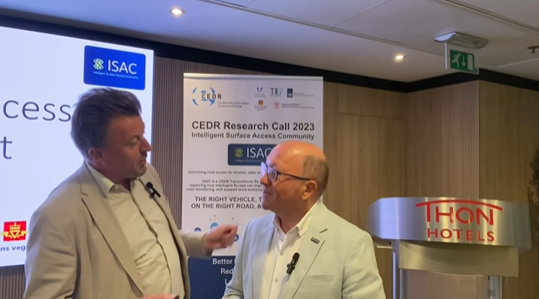
"If there is one lesson Europe should take from projects such as ISAC, it is that technology is no longer the principal barrier. The real challenge is interoperability. Freight transport is inherently European. A vehicle travelling across several Member States cannot operate under completely different digital compliance environments in every jurisdiction. We therefore need common architectures, common standards and trusted data-sharing mechanisms. This is precisely where the broader ITS ecosystem can contribute. Our ERTICO Projects involving digital freight information, logistics data spaces, connected vehicles and cross-border data exchange are creating the foundations that Intelligent Access will require."
By linking the regulatory rules of the Weights and Dimensions Directive with the digital capabilities developed across ERTICO projects, Europe can build an interoperable ecosystem where Intelligent Access acts as a seamless enabler of green efficiency and smart policy.
During the event, Joost also exchanged ideas with CEDR's Secretary-General, Steve Phillips, on the related research programme on Intelligent Access for road freight.
Vantomme comments, "Thank you, Steve and the CEDR community. Pleased to contribute to the panel discussion with DG MOVE and other industry actors. For us at ERTICO - ITS Europe, the win-win with the road authorities is clear. NRAs rely on visual counts, counting loops, weighing loops, and surveys, which offer limited insight and control over road usage by freight transport. Intelligent Access leverages data from freight vehicles and transport companies to align road usage with the conditions set by NRAs. The objective of Intelligent Access is to ensure 'the right vehicle with the right load on the right road at the right time,' utilising digitisation
and connected vehicles. Looking forward to our strengthened cooperation."
Discover more about our Partnership and how we contribute to a safer, smarter and more sustainable mobility future through our portfolio of EU-funded projects.
Watch our newly released Annual Video