
There were just two mentions of the word ‘transport’ in the European Commission President Ursula von der Leyen’s State of the European Union (SOTEU) address yesterday; yet the President’s emphasis on competitiveness, AI, digitalisation, clean energy, resilience and strategic autonomy hit home with ERTICO and the wider Intelligent Transport Systems community. ITS provides the building blocks of a more connected, efficient and resilient network and points to a mobility and transport system in which physical infrastructure and digital intelligence are becoming inseparable.
In her speech, President von der Leyen delivered an urgent warning: “… our future prosperity and security will greatly depend on how we manage the tipping points of our time: climate change and AI”. For Europe’s transport and mobility systems, these two tipping points present challenges to be tackled head on.
To counter the effects of climate change and human-made disasters, resilience needs to be designed into digital and physical infrastructure, rather than treated as an emergency response alone. Intelligent networks, real-time data, dynamic traffic management and emergency mobility solutions can help Europe anticipate, manage and recover from climate-related events. The same principle applies to Europe’s strategic resilience and security, which highlight the importance of interoperable, digitally managed transport networks. Europe’s transport corridors must be capable of supporting the movement of people and goods efficiently in normal times, while also remaining operational when circumstances change.
On the second tipping point, AI, the President included ‘transport’ as being among “five of the highest-value sectors in which industrial AI has the biggest potential”. ITS has a big role to play in fulfilling the ambition to move AI “from the screen to the real economy and society”. Transport is one of the sectors where Europe has both the data and the industrial base to develop high-value AI applications from intelligent traffic and logistics management to cooperative, connected and automated mobility. The real opportunity lies in connecting these applications: vehicles, infrastructure, networks, services and users must become part of an integrated mobility ecosystem. The challenge now is to turn successful applications into solutions that can be deployed across the Single Market.
President von der Leyen’s commitment to completing the Single Market and reducing regulatory fragmentation is therefore particularly welcome. In mobility, this means turning interoperability from a technical principle into a reality: common frameworks, compatible standards, accessible data and coordinated investment that allow solutions to move with fewer barriers across Europe.
Exactly a week before the SOTEU, ERTICO and its Partnership celebrated our 35-year anniversary in the historic Brussels City Hall. Looking back at ERTICO’s origins in 1991 was a reminder that our story has always been closely connected to a simple European ambition: creating the conditions for innovation to work across borders. The Single Market was taking shape around the same time, with the ambition of removing the barriers that prevented European businesses, people and ideas from moving freely across Europe.
That ambition remains highly relevant to mobility today. A solution developed in one European city or Member State should not have to be redesigned from the ground up to work in another. For innovative mobility companies, scale is what allows solutions to mature, investment to follow and European innovation to compete globally.
Turning these ambitions into reality will require several shifts. First, Europe needs to scale deployment, not simply fund innovation. Second, data must become more usable, trusted and interoperable, with clear frameworks for sharing between public authorities, infrastructure operators, industry, researchers and service providers. And third, investment and regulation need to reinforce deployment, providing the long-term certainty required to build infrastructure and develop solutions across borders.
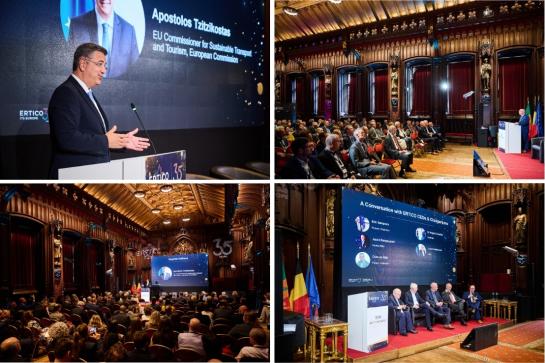
In his opening keynote at ERTICO’s 35-year celebration, Commissioner for Sustainable Transport and Tourism, Apostolos Tzitzikostas, rightly pointed out that the transition to smarter, safer and more resilient mobility is becoming a defining issue for Europe’s future. Accelerating the deployment of ITS will be critical for strengthening Europe’s technological and industrial position, making better use of infrastructure and data, and ensuring that innovation translates into tangible benefits for citizens.
Europe has many of the ingredients for global leadership in intelligent and connected mobility. The opportunity identified in this State of the European Union is to bring those ingredients together.
Joost Vantomme
CEO, ERTICO-ITS Europe
Access the Vision 2035 Brochure for more information about ERTICO's future direction with strategic areas and supporting outcomes and enablers.
