

The ERTICO team within the SUM project organised its Final Annual event during the Transport Research Arena (TRA) 2026 in Budapest, bringing together more than 80 participants from across Europe’s urban mobility ecosystem. Representatives from cities, research organisations, mobility operators, industry and policymaking bodies gathered to reflect on three years of collaboration advancing seamless shared urban mobility and to discuss the future of sustainable, integrated transport solutions.
The event marked an important milestone for the project, showcasing achievements from nine Living Labs and exploring how successful shared mobility initiatives can move beyond pilot phases to become permanent elements of urban transport systems. Discussions focused on the governance, interoperability, data-sharing and multimodal integration needed to support long-term deployment across European cities.
From innovation pilots to integrated mobility systems
A key theme throughout the event was the recognition that transforming urban mobility requires more than technological innovation. Speakers highlighted the importance of combining digital tools and mobility services with supportive policies, long-term operational planning, inclusive governance and behavioural change strategies.
Over the past three years, SUM has demonstrated that shared mobility services deliver the greatest impact when integrated into wider multimodal ecosystems, closely connected with public transport networks and embedded within strategic planning frameworks such as Sustainable Urban Mobility Plans (SUMPs).
Across its nine Living Labs, SUM tested a range of interventions, including demand-responsive transport (DRT), mobility hubs, Mobility as a Service (MaaS), integrated ticketing systems, predictive fleet availability tools, bike-sharing schemes and multimodal journey planning solutions. These measures were implemented not as isolated technologies, but as tools to support broader objectives including improved accessibility, reduced greenhouse gas emissions, stronger public transport networks and lower dependence on private vehicles.
Living Labs shared practical implementation lessons
Partners from several Living Labs presented their experiences and lessons learned from deployment in real-world urban environments.
In Athens and Penteli, initiatives focused on e-bike sharing, mobility hubs, MaaS solutions and the reallocation of street space as part of wider efforts to create more liveable and people-centred cities. The experience underscored the need to align digital mobility services with urban design, accessibility and user incentives.
Munich demonstrated how hybrid car-sharing models combining free-floating and station-based services can improve flexibility and coverage while strengthening connections with public transport. The city also showcased mobility hubs, the repurposing of parking spaces and simulation tools designed to better understand user behaviour and operational performance.
Kraków highlighted the role of demand-responsive transport in complementing existing public transport services. Since its launch in February 2025, the LajkBus service has recorded more than 50,000 passengers and over 41,000 bookings, improving accessibility in underserved areas while demonstrating the importance of real-time monitoring and operational optimisation.
Coimbra shared experiences from implementing flexible passenger transport services in lower-density and peripheral areas. While accessibility measures such as call-centre booking support proved valuable for elderly and digitally excluded users, the Living Lab also highlighted the importance of service reliability for long-term user confidence and adoption.
Other Living Labs presented complementary approaches. Geneva showcased its expanding network of mobility hubs developed through extensive collaboration with municipalities and mobility operators. Jerusalem demonstrated how cycling infrastructure and bike-sharing services can be effectively integrated with high-capacity public transport corridors. Rotterdam presented its predictive fleet availability API, integrated into the RET MaaS application, enabling real-time visibility of shared mobility vehicle availability. Larnaca highlighted positive impacts from integrated ticketing and bike-sharing measures, while Fredrikstad shared progress on its autonomous electric ferry initiative aimed at reducing regional car traffic.
Building the policy framework for future deployment
The final event also highlighted policy recommendations developed throughout the project. Presented by POLIS Network, the recommendations draw on the experiences of the Living Labs and extensive engagement with cities, mobility stakeholders and related European initiatives.
The recommendations call for stronger data-driven governance, improved interoperability between mobility systems, more inclusive access to services and sustainable operational and financial models for shared mobility deployment. A central message emerging from the project is that shared mobility should be integrated into broader transport, land-use and climate policies rather than treated as a standalone innovation.
Ensuring a lasting project legacy
Among the project’s most significant long-term outcomes is the SUM Open Data Platform, which will remain accessible beyond the project’s lifetime. The platform provides access to key performance indicators, intervention monitoring tools, city profiles and analytical insights generated through the nine Living Labs.
Together with datasets made available through Zenodo, the platform will support future research, evidence-based policymaking and the replication of successful shared mobility solutions across Europe.
Collaboration remains key
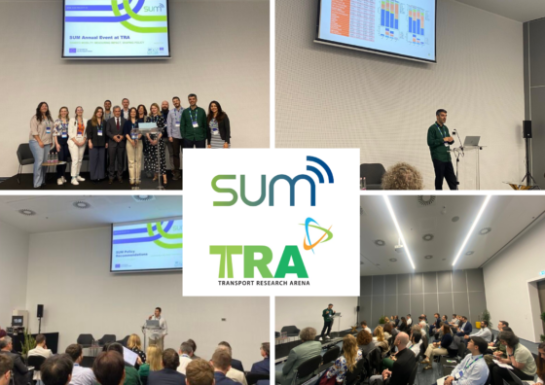
The event concluded with a clear message: collaboration will remain essential to achieving sustainable urban mobility goals. Participants emphasised the need for continued cooperation between cities, mobility providers, researchers, policymakers and local communities, supported by long-term commitments to open data, innovation and citizen engagement.
As the SUM project concludes, its results provide valuable evidence and practical guidance for cities seeking to accelerate the transition towards more sustainable, integrated and user-centred mobility systems.
SUM Annual Event Practical infoThursday 11 okt 2025 - 14:15 - Thursday 11 okt 2025 - 16:30Discover the SUM Open Data Platform Practical infoFriday 3 okt 2026 - 11:00 - Friday 3 okt 2026 - 12:15EU-projects at TRA 2026: Connecting research, deployment and policy for European mobility New Guidelines for European Cities' Sustainable Urban Mobility Planning SUM project hosts Final Annual Event during Transport Research Arena 2026